Historical Title Search Victoria
Trace every transaction, owner, covenant, easement and Section 173 agreement registered against a Victorian property — from the current title back to the original Crown grant. Victorian Titles Office records with paper title images included for the pre-digital era. Bespoke service run by our experienced staff.
Indicative pricing from $45 per historical title. We quote each job.
A VIC title search, checked and summarised for you
Plenty of services will email you the title PDFs and leave you to make sense of them. Our experienced staff check every search and send it back with a short plain-English summary — which covenant is binding, which Section 173 has been spent, which easement is relevant to a setback dispute. If your historical search is for a planning purpose (existing use rights, covenant interpretation, boundary disputes, development DD), this is the difference between raw records and a usable result.
When you'd run a historical title search in Victoria
The most common Victorian use cases.
Existing use rights under s63 / s64 / s65
Establishing that a use existed and continued before a planning scheme change is one of the most common reasons we run a Victorian historical title search. The title history won't always prove use directly, but combined with rates records, building approvals and aerials it often supplies the missing date — when the land changed hands, when a Section 173 was lodged, when a use was first registered. Critical for existing-use-rights evidence under the Planning and Environment Act 1987.
Covenant interpretation
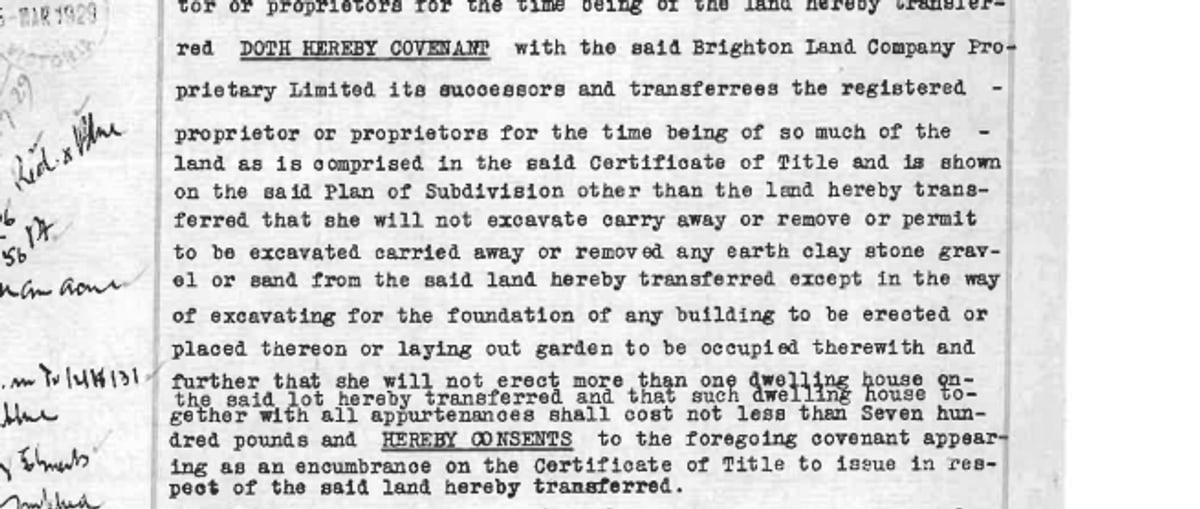
If the covenant is still registered you don't need a historical search to read it — its dealing number is on the current title, so the instrument itself can be ordered with a current title search. Where the historical search earns its cost is working out which land actually holds the benefit. Older covenants define the benefited land by reference to the lots as they stood at the time: a 1929 covenant will bind you in favour of "the rest of the land on the plan of subdivision", and those lots have since been subdivided, consolidated and resubdivided many times over. Tracing the chain forward is the only way to identify today's beneficiaries — which you must do before lodging under Clause 52.02, and which also shows whether the benefiting land has been alienated, potentially rendering the covenant unenforceable. The historical record likewise carries covenants and restrictions since removed, varied or spent, which the current title no longer shows.
Section 173 agreement history
Section 173 agreements run with the land and stay registered on the title even when their original purpose has been spent. A historical search retrieves the original deed so you can see exactly what was agreed, what the trigger conditions were, whether the obligations have been satisfied, and whether the council has the right to enforce. Frequently the difference between a permit application proceeding and being refused.
Boundary, easement and access provenance
Where a contemporary survey conflicts with what's on the ground, the historical chain of titles and plans of subdivision usually resolves it. Same for unregistered easements, carriageway rights, and the question of who installed and maintained a drain or sewer running through your site. The historical record is often the only authoritative answer in inter-neighbour disputes.
Development due diligence
Before settling on a Victorian development site, a historical title search reveals the prior owner sequence, the date and price of past sales, any caveats or rescissions that didn't make it onto the current title, and the timing of consolidations or subdivisions. Often surfaces issues that a current title alone hides — partial extinguishments, variations to covenants, and old Section 173s that constrain what the site can be used for.
Capital gains tax (CGT) records
If you've inherited or held a Victorian property a long time and need the acquisition date or price for CGT, the historical title shows exactly when and how the property was acquired and at what consideration. Documentary evidence registered with the Victorian Titles Office — the ATO accepts it as authoritative. Faster and cheaper than reconstructing the file from old conveyancing records.
Genealogy and family history
Tracing who owned a family property over the decades — including transmissions on death, family transfers and old mortgages — produces a documentary record that's often more reliable than family memory. Victoria has continuous registered records back to the original Crown grant; for inner Melbourne properties that can be the 1840s.
How the Victorian system works
Victorian land titles are administered by the Victorian Titles Office. Victoria operates a Torrens system with the chain of registered titles running back to the original Crown grant for nearly every parcel.
For the digital era (titles registered or converted in recent decades), the historical search returns the full register entries in chronological order. For the pre-digital era, you receive a scanned copy of the actual paper title, with all transactions stamped or noted on it — the same physical document the registrar maintained at the time. The paper title is bundled into the historical search at no extra charge, which makes the Victorian search cleaner than equivalent processes in NSW.
The historical search will show, for each entry: the date of registration, the type of dealing (transfer, mortgage, caveat, covenant, Section 173 agreement, easement, lease, etc.), the parties, and the dealing reference number. From that you can order copies of the specific dealings that matter — the text of an old covenant, the easement instrument, the original Section 173 conditions.
For Victorian planning permit work, a historical title search paired with an existing-use-rights, covenant or Section 173 question is one of the highest-value research tasks we run — the raw cost is small relative to what it reveals.
Indicative Victorian pricing
Bespoke service quoted per job. Figures below are typical registry pass-through costs — your final quote depends on the number of historical documents retrieved, the age of records, and any additional dealing copies required.
All prices include GST unless noted. We confirm a firm quote within one business day of your enquiry.
| Item | From |
|---|---|
Historical title search (per title) Shows every transaction stamped on the title — dates, times, all parties, dealing references. Paper title copies included for the era before digitisation. | $45 |
Each additional historical dealing (covenants, s173, easements) Specific registered dealings referenced on the title — covenant terms, Section 173 conditions, easement grants. We identify which dealings matter for your purpose. | from $20 |
Registry fees are pass-through and subject to change by the Victorian Titles Office. Pricing is per document — we confirm the final quote after reviewing your request.
What you'll receive
- The full historical title chainEvery registered transaction in chronological order — transfers, mortgages, caveats, easements, covenants, Section 173 agreements, leases. Each entry includes the date, dealing type, parties and reference.
- Paper title images for the pre-digital eraScanned copies of the original paper titles with transactions physically stamped or noted on them. Bundled into the historical search at no extra charge.
- Copies of dealings that matter (where required)Where the title refers to a covenant, Section 173 or easement by number only, we can retrieve the full instrument so you can read the burden, the benefit, the exceptions and any variations.
- Plain-English summaryA short written explainer tying the documents to your question — which restrictions still bind, which have been spent, what the historical record means for your planning, CGT or due-diligence point.
- PDF delivery, one job referenceEverything arrives by email as PDFs. We keep one job reference for your file so re-orders and follow-up dealings stay tidy.
VIC historical title search — FAQ
What it is, what it costs, how the Victorian system works.
What is a historical title search in Victoria?
How much does a Victorian historical title search cost?
What information does a Victorian historical title search show?
How far back does a Victorian title history go?
What is a paper title and will I receive a copy?
How do I find out who previously owned a property in Victoria?
Can a historical title search help with capital gains tax (CGT)?
Can I find historical covenants and Section 173 agreements through a title history search?
What's the difference between a current title search and a historical title search?
How long does it take to receive my results?
Do I need to own the property to order a historical title search in Victoria?
Why use us rather than a generic title search service?
Request an indicative Victorian quote
Tell us the property and what you're trying to find out. We'll come back within one business day with an indicative quote and timeframe.
Related
- Historical Title Search (Australia overview) — how VIC, NSW, QLD, TAS and SA compare.
- Current VIC Title Search — for permit applications and contracts; instant order.
- Detailed Planning Assessment — pairs well where the question is “what can I do with this land?”.
- Business Use Check — for existing-use-rights questions, combine with a historical search.